Arboris Founder and Director Jiaqin Li Attends Hong Kong Web3 Festival 2026: From Digital-Asset Narratives to Governed Financial InfrastructureHero Image | Image 1 Image caption: Jiaqin Li, Founder and Director of Arboris Global Partners, at Hong Kong We
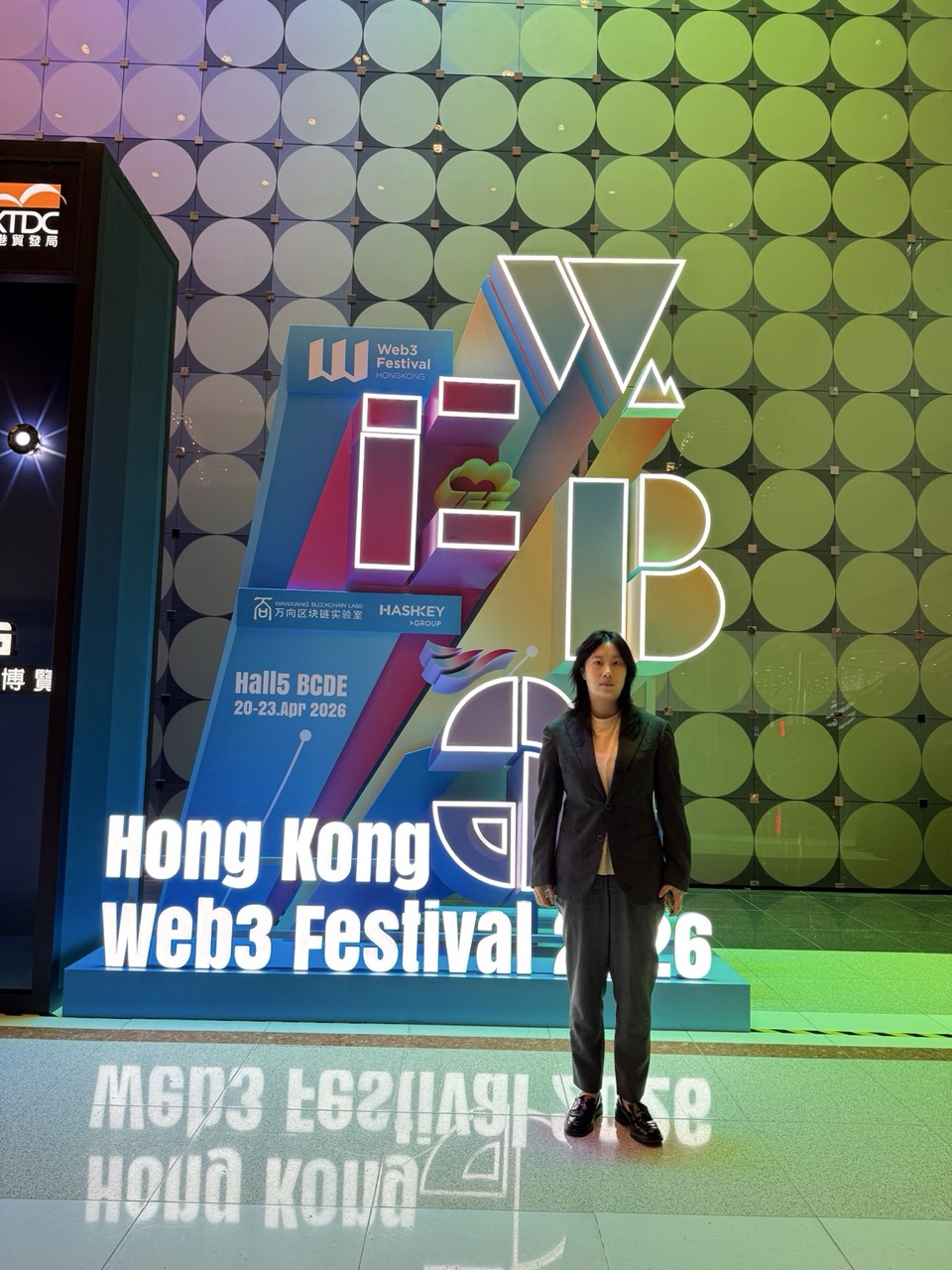
Jiaqin Li, Founder and Director of Arboris Global Partners, at Hong Kong Web3 Festival 2026, held at the Hong Kong Convention and Exhibition Centre from 20 to 23 April 2026.
Jiaqin Li, Founder and Director of Arboris Global Partners, attended Hong Kong Web3 Festival 2026 at the Hong Kong Convention and Exhibition Centre. The four-day programme brought together regulators, financial institutions, technology companies, investors, researchers and infrastructure providers to examine the continuing development of digital assets and blockchain-enabled financial systems. Jiaqin Li’s position as Founder and Director is stated on Arboris’s official leadership page.
The 2026 edition featured more than 20 sessions across four stages, with over 200 speakers and more than 100 participating partners. Its principal themes included crypto finance, the convergence of artificial intelligence and Web3, real-world asset tokenisation, stablecoins, digital payments and the institutional adoption of blockchain infrastructure.
For Arboris, the significance of the festival extended beyond short-term movements in crypto markets. The programme reflected a broader transition: Web3 is increasingly being discussed not as a standalone asset class, but as a potential layer of financial infrastructure connecting assets, payments, data, identity, custody and settlement.
This transition changes the questions that professional and institutional participants need to ask. Technical functionality alone is insufficient. Systems intended to support financial activity must also establish legally enforceable rights, robust custody arrangements, reliable valuation, operational resilience, effective cybersecurity, appropriate disclosure and clearly defined accountability.
Hong Kong Moves from Policy Formation to Regulated Implementation
Hong Kong Financial Secretary Paul Chan described 2026 as an important stage in the maturation of Web3. In his opening address at the festival, he noted that financial institutions were increasingly using digital assets and tokenisation to improve efficiency, reduce costs and shorten settlement cycles. He also highlighted the potential convergence of agentic AI and blockchain infrastructure across finance, trade, wealth management, supply chains and logistics.
The address also identified the conditions required for this transition. If AI agents are able to analyse information and execute actions at machine speed, payment and settlement systems must become correspondingly faster. At the same time, common standards, cross-border cooperation, traceable decision-making, human intervention mechanisms, cybersecurity and institutional accountability remain necessary. Hong Kong’s stated regulatory approach continues to apply the principle of “same activity, same risks, same regulation.”
This policy direction is increasingly visible in the market’s operating framework. On 10 April 2026, the Hong Kong Monetary Authority granted stablecoin issuer licences to Anchorpoint Financial Limited and The Hongkong and Shanghai Banking Corporation Limited under the Stablecoins Ordinance. The HKMA stated that the regime was intended to provide an orderly operating environment while maintaining user protection and effective risk management.
On 20 April, the Securities and Futures Commission also introduced a regulatory framework permitting secondary trading of tokenised SFC-authorised investment products, subject to requirements governing trading channels, pricing, liquidity, disclosure, client onboarding and operational controls.
Taken together, these developments indicate that Hong Kong’s digital-asset strategy is progressing from policy statements and controlled experimentation towards regulated issuance, distribution, trading and settlement infrastructure.
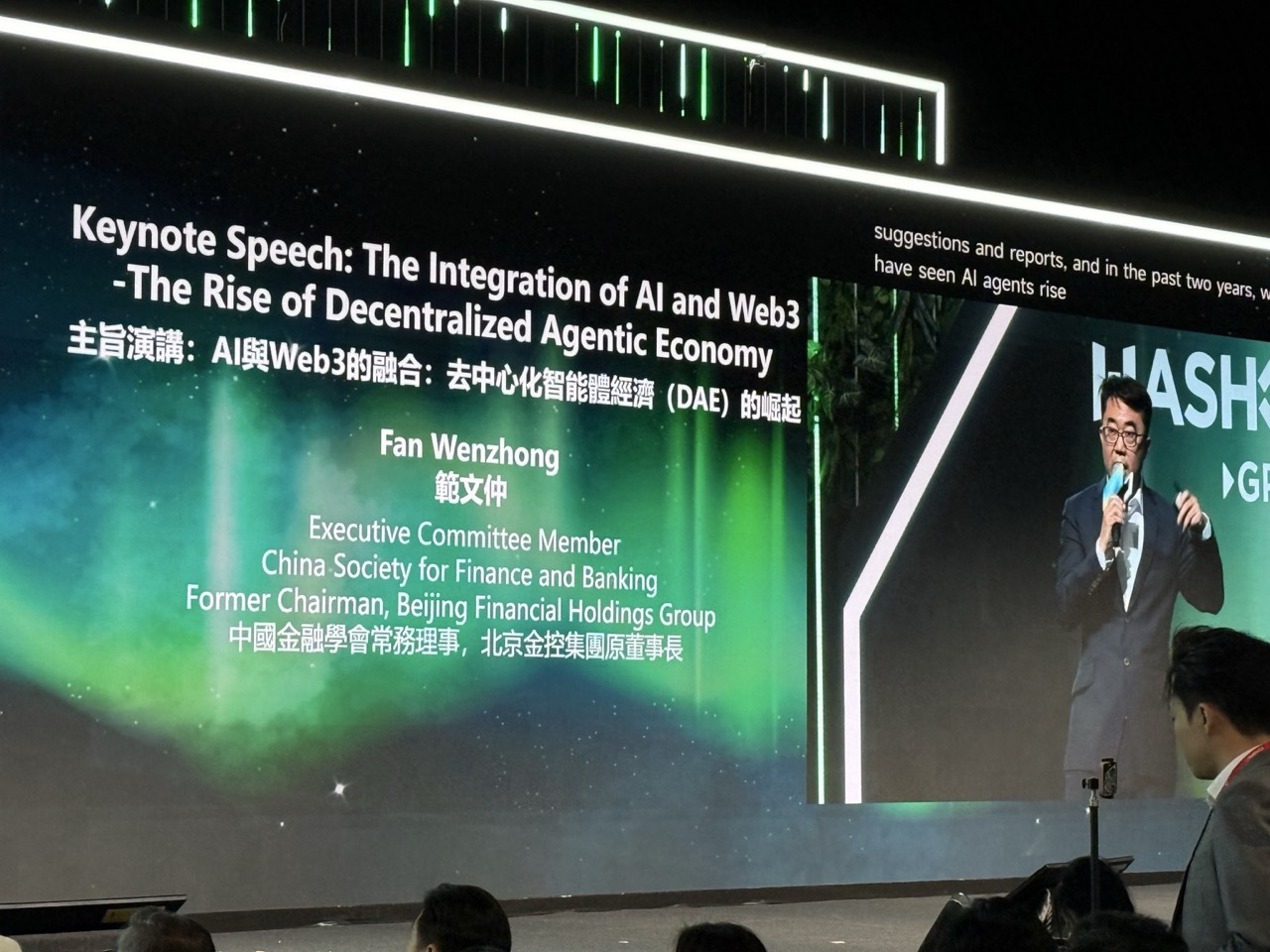
Fan Wenzhong, Executive Committee Member of the China Society for Finance and Banking and former Chairman of Beijing Financial Holdings Group, delivers the keynote address, “The Integration of AI and Web3 — The Rise of Decentralized Agentic Economy.”
AI and Web3: Building an Economic Framework for Autonomous Agents
One of the sessions followed during the festival examined the integration of artificial intelligence and Web3 through the concept of a Decentralized Agentic Economy.
The session title reflected a wider issue now facing digital infrastructure. AI agents are evolving from systems that generate information into systems capable of planning, communicating and executing tasks. When those tasks involve payments, asset transfers, contractual obligations or access to financial services, an AI system requires more than computational intelligence. It also requires a verifiable identity, an authorised scope of action, access controls, transaction rules and a mechanism for recording and auditing its activities.
Blockchain systems may provide some of these components through programmable payments, smart contracts, cryptographic identity and tamper-resistant records. However, the availability of technical mechanisms does not resolve the institutional questions that follow.
Organisations deploying autonomous agents must determine who defines the agent’s authority, which activities require human approval, how transactions are monitored and how responsibility is assigned when a model produces an incorrect or unintended outcome. They must also establish procedures for suspending an agent, reversing or remediating transactions where legally possible, managing compromised credentials and responding to conflicts between automated instructions and regulatory obligations.
From Arboris’s perspective, the convergence of AI and Web3 is therefore not a removal of governance. It represents a need to translate governance into systems that can operate at machine speed while remaining subject to identifiable human and institutional responsibility.
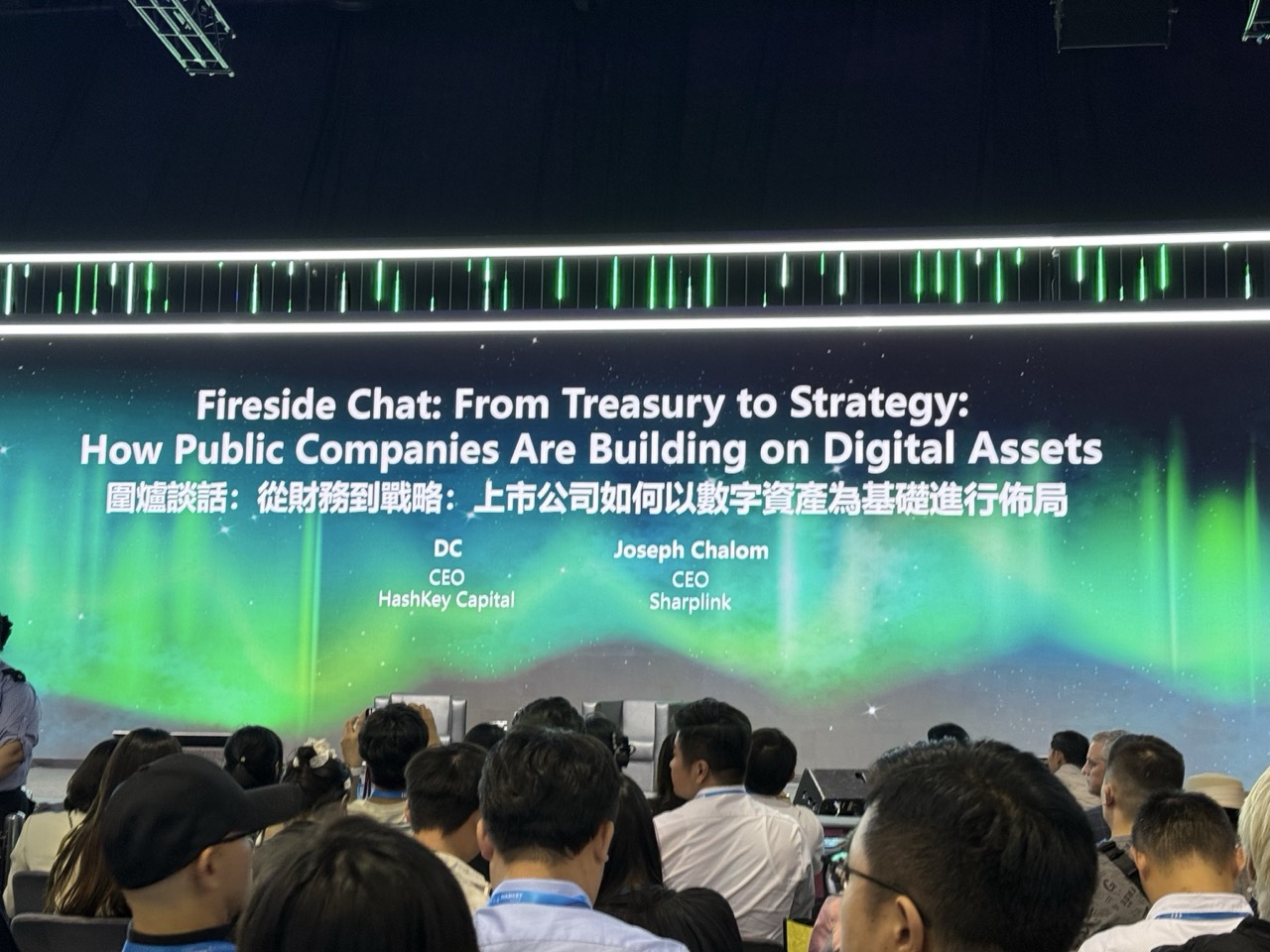
The programme screen introduces the fireside chat “From Treasury to Strategy: How Public Companies Are Building on Digital Assets,” featuring DC, Chief Executive Officer of HashKey Capital, and Joseph Chalom, Chief Executive Officer of SharpLink.
From Treasury Exposure to Corporate Strategy
The distinction between treasury exposure and corporate strategy was another relevant theme of the festival.
When a company holds a limited amount of digital assets on its balance sheet, the decision may be treated primarily as an allocation or treasury-management matter. Once digital assets become connected to financing, collateral, customer payments, liquidity management, capital raising or the company’s broader commercial model, the decision affects a substantially wider range of organisational responsibilities.
For a public company, a digital-asset strategy should therefore be evaluated through the same governance disciplines applied to other material financial activities. These include board-approved mandates, concentration limits, custody and private-key arrangements, counterparty assessment, valuation policy, liquidity planning, accounting treatment, financial disclosure, cybersecurity and adverse-scenario management.
A credible strategy should also explain the economic function of the asset. Market exposure alone does not establish a strategic rationale. Institutions need to understand whether the asset is intended to support treasury diversification, payment efficiency, access to on-chain liquidity, customer acquisition, network participation or another operational objective.
The distinction is material for capital analysis. A digital asset held as a balance-sheet position is principally an allocation decision. Digital-asset infrastructure embedded within a company’s operations represents a broader transformation involving governance, technology, regulation, risk management and organisational capability.
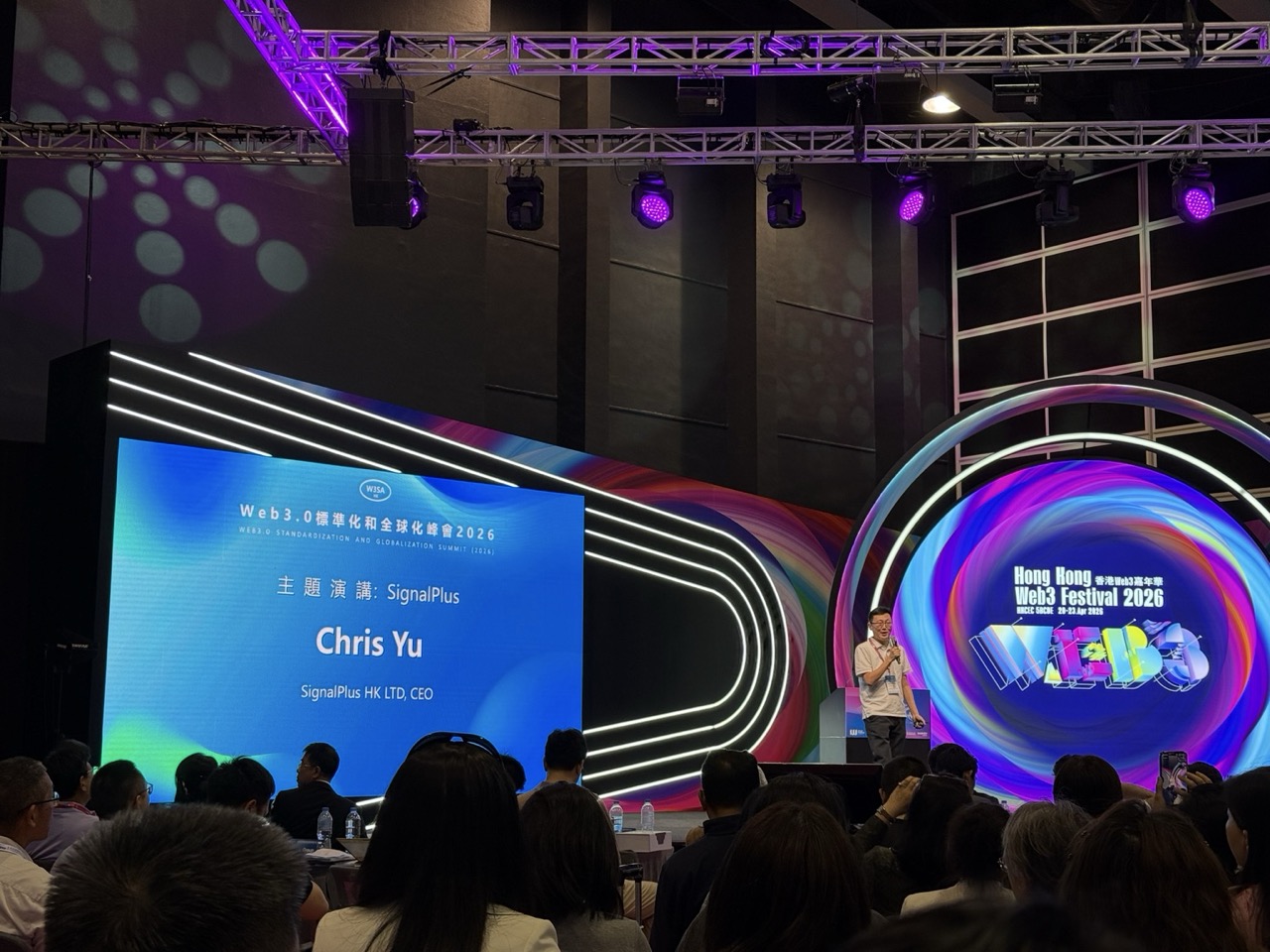
Chris Yu, Chief Executive Officer of SignalPlus HK Ltd, delivers a keynote presentation at the Web3.0 Standardization and Globalization Summit 2026.
Standardisation as a Requirement for Institutional Scale
The Web3.0 Standardization and Globalization Summit was held on 22 April as a dedicated forum within the festival. Organised by the Hong Kong Web3.0 Standardisation Association and hosted by AIMall Tech, the forum focused on the role of common standards in advancing blockchain adoption, cross-regional cooperation and the integration of Web3 systems with established industries.
Standardisation is particularly important for asset tokenisation. The creation of a digital token does not, by itself, establish the nature or quality of the asset it represents. Institutional adoption requires alignment between the on-chain record and the underlying legal and economic rights.
A tokenised instrument should clearly identify the underlying asset, the holder’s rights, the responsible issuer, the applicable jurisdiction, custody arrangements, valuation methodology, transfer restrictions, redemption procedures and treatment in the event of insolvency. The technological record must also remain consistent with the legally recognised record of ownership.
Without common standards, two products described as “tokenised assets” may carry materially different legal, financial and operational characteristics. One may represent a direct and enforceable claim over an underlying asset, while another may provide only a contractual claim against an intermediary.
Standards cannot eliminate investment or operational risk. Their practical role is to establish a common framework through which issuers, investors, custodians, auditors, technology providers and regulators can assess the same transaction.
Cross-border structures introduce an additional layer of complexity. An asset may be issued in one jurisdiction, recorded through infrastructure in another, held by a custodian in a third and acquired by investors subject to different securities, tax and eligibility rules. Technical interoperability does not automatically create legal or regulatory interoperability.
For Arboris, this reinforces the importance of examining tokenisation as a complete structure rather than as an isolated technology. The quality of the underlying rights, governance and execution remains more important than the digital format through which an interest is recorded.
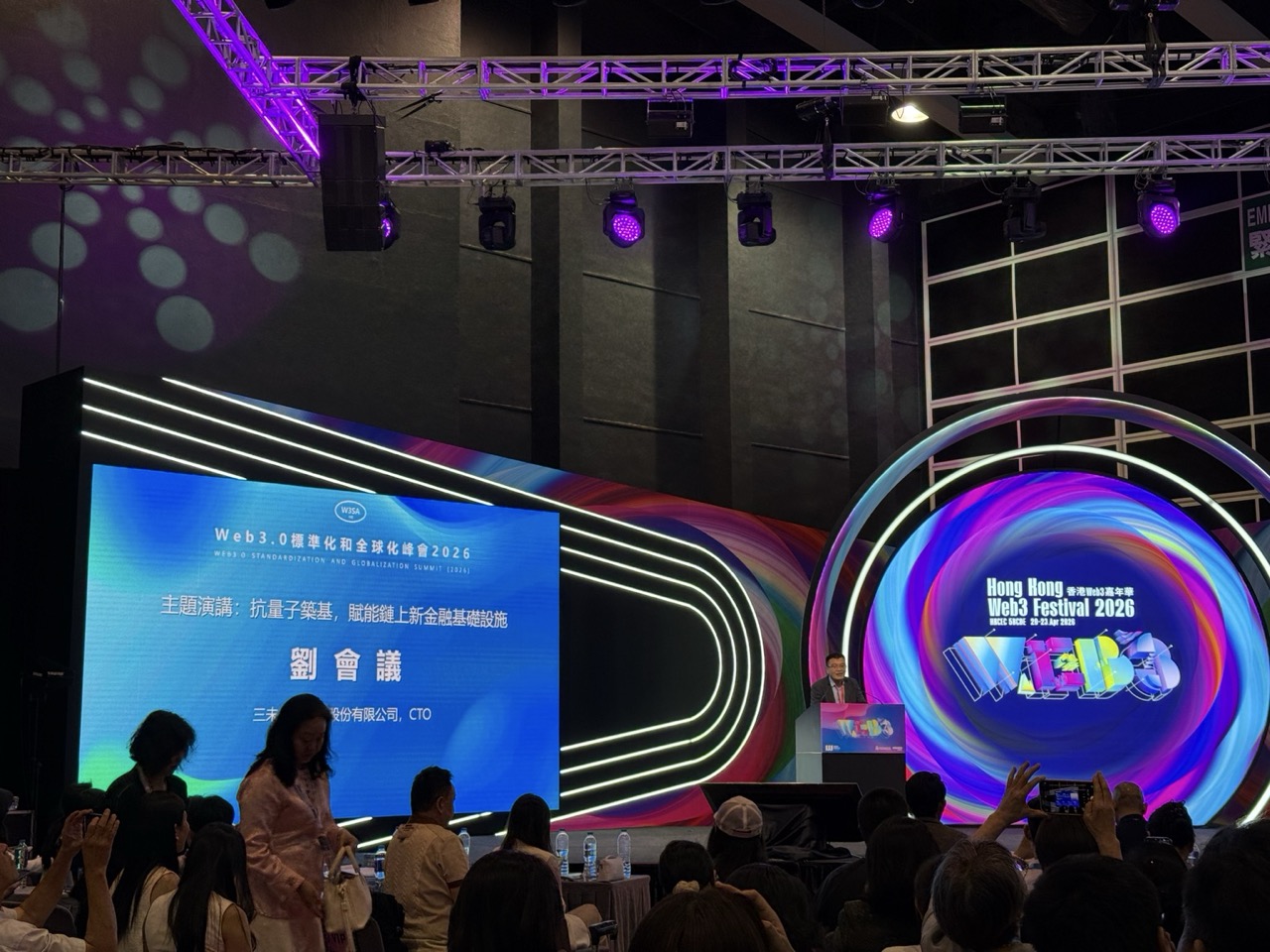
Liu Huiyi, Chief Technology Officer of Sansec Technology Co., Ltd., delivers the keynote “Building Quantum-Resistant Foundations to Empower New On-Chain Financial Infrastructure.”
Quantum-Resistant Security and the Life Cycle of Financial Infrastructure
The session on quantum-resistant foundations introduced a longer-term security question for blockchain-based finance.
Financial ownership records, contractual rights, identity credentials and cryptographic keys may need to remain secure for many years. The useful life of these records may be substantially longer than the life of the cryptographic systems originally used to protect them.
The US National Institute of Standards and Technology released its principal post-quantum cryptography standards in 2024 and now advises organisations to begin migrating systems towards quantum-resistant cryptography. NIST has also stated that organisations should identify where quantum-vulnerable algorithms are used and develop plans for replacing or updating them.
For institutions assessing blockchain and tokenisation infrastructure, the immediate issue is not whether existing encryption will suddenly cease to function. The more practical consideration is cryptographic agility: whether algorithms, keys and security protocols can be changed without invalidating ownership records, interrupting operations or creating unacceptable migration risk.
This issue becomes especially relevant where tokenised assets, fund interests, ownership registers or investor entitlements may remain in force for decades. Infrastructure designed only around present-day security assumptions may become costly or difficult to update later.
Long-duration financial systems should therefore include upgrade mechanisms, asset and key inventories, clear responsibility for cryptographic migration, tested recovery processes and procedures for maintaining continuity between old and new security standards.
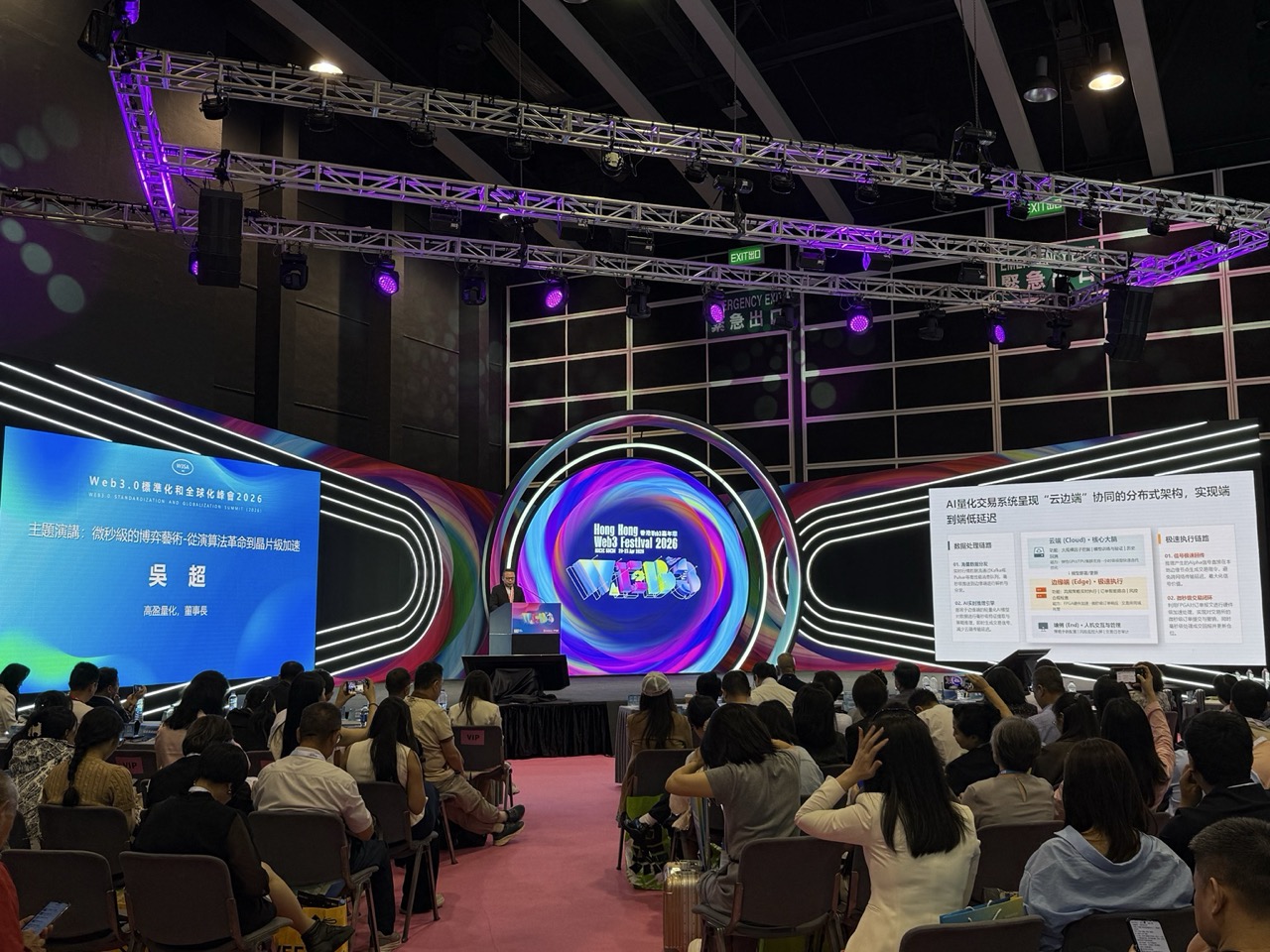
Wu Chao, Chairman of Gaoying Quantitative, delivers the keynote “The Art of Microsecond-Level Competition: From Algorithmic Revolution to Chip-Level Acceleration.” The accompanying slide presents a cloud–edge–end distributed architecture designed to achieve end-to-end low latency in AI quantitative-trading systems.
Speed Creates Value Only When Accompanied by Control
The presentation on microsecond-level competition illustrated the increasingly close relationship between trading strategy, artificial intelligence, distributed computing and specialised hardware.
Lower latency can improve execution, reduce the delay between market information and trading decisions, and support faster coordination across automated systems. In highly competitive markets, relatively small differences in processing and transmission speed may affect pricing, liquidity provision and execution quality.
However, faster infrastructure also reduces the time available to detect an error and intervene. A flawed model, incorrect input, compromised account or poorly configured risk limit can generate consequences more quickly when decisions and transactions are executed automatically.
For this reason, improvements in speed must be accompanied by equivalent improvements in pre-trade controls, real-time exposure monitoring, model validation, access management, system redundancy, audit trails and emergency intervention mechanisms.
The relevant institutional objective is not maximum speed in isolation. It is reliable and auditable speed operating within clearly defined risk limits.
This principle also applies to the broader convergence of AI and Web3. Infrastructure capable of executing transactions at machine speed must preserve the ability to identify who authorised an action, which rules governed it, what data informed the decision and how an abnormal outcome can be contained.
Arboris’s Observations
Across the sessions followed during Hong Kong Web3 Festival 2026, several connected developments were evident.
First, digital assets are increasingly being integrated into a broader financial architecture. Stablecoins, tokenised funds, tokenised deposits, programmable payments and AI-enabled financial systems depend on shared infrastructure for identity, custody, compliance, settlement and reporting.
Second, institutional adoption will be determined less by the novelty of a technology than by the quality of its implementation. Moving an asset or transaction on-chain does not automatically establish enforceable ownership, reliable valuation, liquidity, security or investor protection.
Third, governance is becoming more important as systems become more automated. AI agents, smart contracts and low-latency trading systems can reduce manual processing, but they also require more precise permissions, monitoring, escalation and accountability.
Fourth, cross-border opportunity remains inseparable from cross-border complexity. Digital-asset structures may simultaneously engage securities law, licensing, taxation, custody, insolvency, data and financial-promotion rules in several jurisdictions.
For wealth managers, family offices and institutional clients, due diligence should therefore examine the full structure: the legal status of the asset; the rights represented by the token or instrument; the quality of the underlying asset or cash flow; custody and key management; cybersecurity; liquidity and valuation; settlement arrangements; disclosure; and governance.
Jiaqin Li’s attendance at the festival forms part of Arboris’s continuing engagement with developments across digital finance, institutional infrastructure and cross-border capital markets.
Arboris will continue to monitor regulated digital-asset infrastructure, tokenisation, stablecoins, AI-enabled financial systems and the development of cross-border standards in Hong Kong and across the wider Asia-Pacific region. The firm’s focus remains on distinguishing durable financial infrastructure from short-term market narratives and assessing whether technological innovation can be translated into transparent, governable and sustainable economic value.
About Arboris
Arboris Global Partners is a Singapore-headquartered wealth and asset management firm serving high-net-worth individuals, family offices and institutional investors across wealth management, asset management, VCC fund solutions, family-office advisory and capital advisory.